


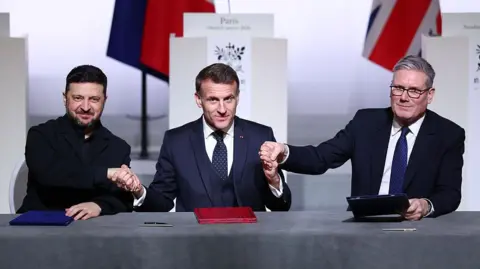
The British and French governments have signed a statement of purpose concerning the deployment of troops in Ukraine if a peace deal be struck with Russia, the UK Prime Minister, Sir Keir Starmer, has declared.
Subsequent to negotiations with allied nations in Paris, he said that the allies would "set up operational bases across Ukraine and construct fortified facilities for weapons and defense matériel" to prevent any subsequent invasion.
The allied nations also suggested that the America would play the primary role in monitoring a ceasefire.
The Kremlin has repeatedly cautioned that any external forces in Ukraine would be considered a "legitimate target", but has not yet issued a statement on this new announcement.
Background and Continuing Hostilities
Moscow's leader Vladimir Putin initiated a major offensive of Ukraine in the start of last year, and Russia currently controls roughly 20% of Ukrainian territory.
"This represents an essential component of our vow to stand with Ukraine for the duration," commented the UK Prime Minister.
National leaders and high-ranking officials from the "Allied Coalition" participated in the recent discussions.
Addressing reporters at a combined announcement, Starmer noted: "It creates the pathway for the legal framework under which allied and coalition forces could work on Ukrainian soil, defending Ukraine's skies and seas, and rebuilding Ukraine's armed forces for the time to come."
The UK prime minister went on to say that London would participate in any US-led confirmation of a prospective cessation of hostilities.
Security Guarantees and Diplomatic Positions
Lead US negotiator Steve Witkoff stated that "long-term safety pledges and strong prosperity commitments are essential to a permanent resolution" in Ukraine – referring to a central requirement made by the Ukrainian government.
The negotiator noted the coalition had "mostly completed" their work on finalizing such guarantees "to ensure the Ukrainian people know that when this war ends, it ends permanently."
Donald Trump's son-in-law, US President Donald Trump's representative, also took part in the discussions.
At the same time, French President Emmanuel Macron stated that Ukraine's partners had made "significant headway" at the talks.
He added that "strong" security guarantees for Kyiv had been reached in the event of a possible truce.
President Volodymyr Zelensky stated that a "huge advance" had been made in the talks, but added that he would only deem efforts to be "sufficient" if they led to the end of the conflict.
Earlier, he suggested a settlement was "90% ready". Settling the last 10% would "shape the outcome of the peace, the destiny of Ukraine and Europe".
Outstanding Matters
- Sovereign soil and defense assurances have been at the center of key disagreements for negotiators.
- Moscow has consistently stated that Ukrainian troops must withdraw from the entirety of Ukraine's eastern Donbas or Russia will occupy it, refusing any compromise over how to conclude the war.
- Zelensky has thus far rejected surrendering any territory, but has proposed that Ukraine could move its forces to an mutually accepted point – but only if Russia follows suit.
Russian forces presently occupies about 75% of the Donetsk region and around 99% of the neighbouring Luhansk region. The two regions form the heartland of the Donbas.
The initial US-led multi-point proposal that was circulated to the media last year was seen by Kyiv and its partners in Europe as being strongly biased in Russia's favor.
This triggered a period of high-level negotiations – with all sides trying to adjust the draft.
Last month, Kyiv presented the US an updated 20-point plan – as well as separate documents detailing potential security guarantees and provisions for Ukraine's reconstruction, he said.